The Shepherd of the Wild: Good Shepherd Sunday
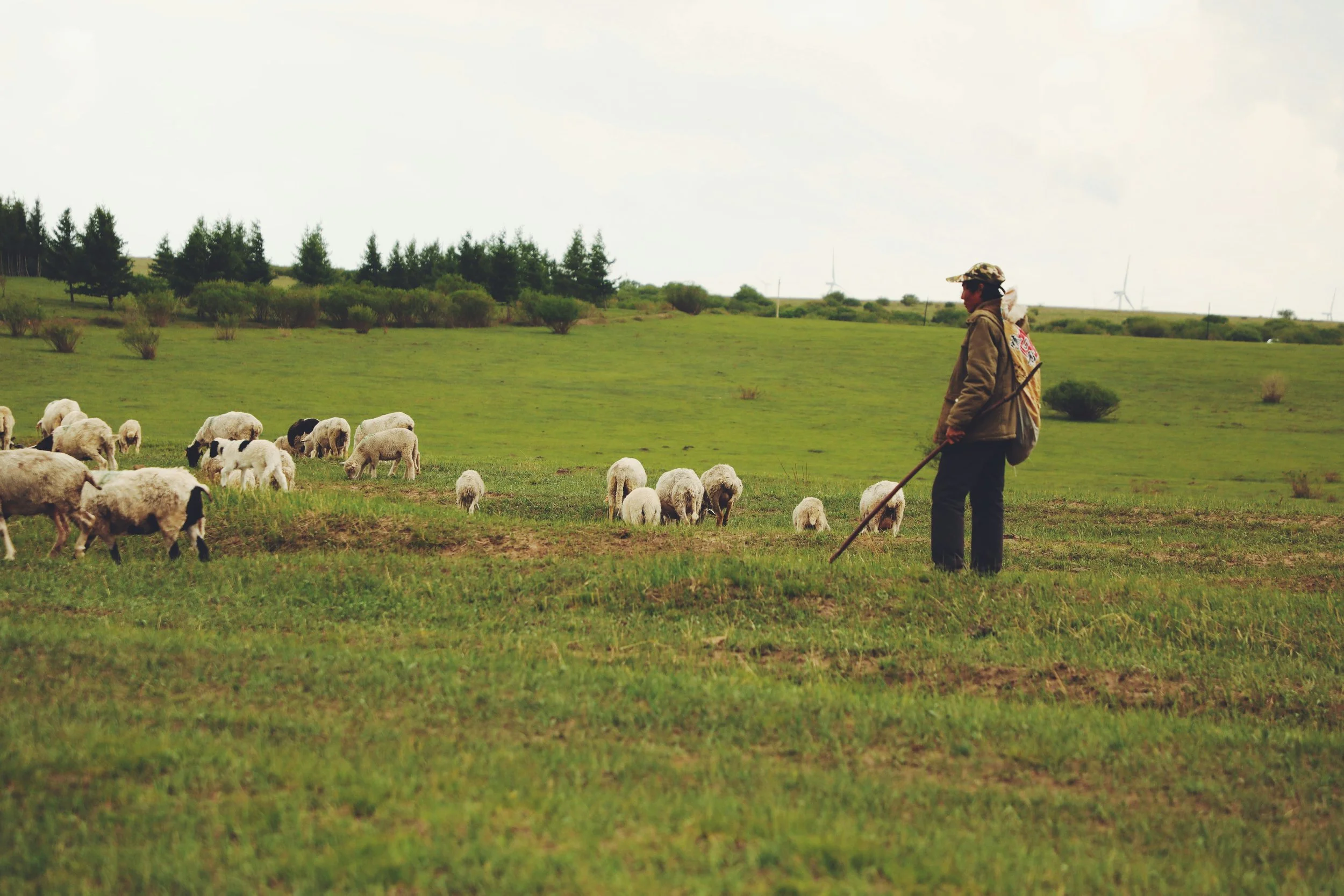
“We talk about people behaving like sheep, which assumes that sheep all behave in the same way. That has not been my experience. Some are affectionate, others prone to head-butting. Some are determinedly self-sufficient, others seek our help when they need it. And some can be trusted to lead the flock home. They are as individual as we are.” The Wisdom of Sheep by Rosamund Young
The Shepherd of the Wild: A Manifesto of Radical Belonging
We all know the "Good Shepherd" of the stained-glass windows—calm, pristine, holding a perfectly clean lamb. But for many of us here today, this image can feel a bit "precious" or even restrictive. In addition, historically, the church has used "shepherding" as a tool for control, demanding blind obedience and telling people to stay "penned in" by rigid dogmas.
Today, we reclaim this image by looking toward the radical, real-world observations of organic farmer Rosamund Young. In her books The Secret Life of Cows and The Wisdom of Sheep, Young shatters the myth that animals—and by extension, ourselves—are a mindless, uniform mass. She shows us that each individual has a distinct personality, specific preferences, and a deep emotional life.
One of her most poignant observations involves a cow named Fat Hat. Most farmers would see a cow away from the herd as a "problem" to be corrected, but Young watched Fat Hat for years and realized she simply preferred her own company. She was an independent spirit who knew exactly where she wanted to be and when.
Young also speaks of an old white ram who, despite being tiny compared to the enormous cows, chose to live with the cattle instead of the sheep. He wasn't forced; he simply preferred their company. When it was time for hay, the giant cows would actually stand back and let him go first. They recognized his authority not because he was big or loud, but because they had negotiated a way of being together that respected his unique presence.
This is the "Wisdom of the Sheep" the ability to judge character and decide who to trust. It reminds us that our "Shepherd" isn't a dictator; the Shepherd is someone who knows that each of us—like Fat Hat or that old ram—needs a slightly different path.
We look at the Shepherd not as a militant commander, not even as an assertive guide, but rather as a leader who serves by deeply knowing us and helping us forward. There is an ancient wisdom from Lao Tzu that says a leader is best when people "barely know that leader exists". This Shepherd doesn't dominate or drive the flock from the front with loud commands. Instead, this Shepherd leads from behind, moving so subtly that the sheep find their own pastures and their own pace. As Lao Tzu taught, when the best leader’s work is done and the goal is achieved, the people say, "We did it ourselves". This Shepherd doesn't just manage a flock; rather calls us into a way of being that celebrates the complexity of our lives and the vastness of the world.
In her April 2024 writing for The Cottage, Diana Butler Bass reflects on the historical reality of the Good Shepherd. She notes that while sheep were vital to the ancient economy and signified wealth for their owners, the actual job of shepherding "often fell to society’s least important members". Women and children were most often shepherds. And these members were regarded with little respect and privilege.
Shepherds were socially expendable. They were seen as "expendable people in menial but necessary jobs," much like the essential workers of today who keep society running but are often ignored or undervalued. Shepherds were often untrustworthy outcasts. Historically, shepherds were held in such low regard that they were often deemed untrustworthy by polite society, sometimes even barred from serving as witnesses in court. Shepherds were symbols of subversion. By choosing the "Good Shepherd" as a primary metaphor, Jesus wasn't picking a symbol of polished leadership. He was identifying with a class of workers who were "lowly, uneducated, and lived on the literal margins of the community".
Bass argues that this choice "dismantles any political or social movement that claims superiority". When we look at the Shepherd, we aren't looking at a king wearing a costume; we are looking at God choosing the specific face and labor of those the world had cast aside to lead the way and walk with us home.
In Psalm 23, the psalmist says, "You prepare a table before me in the presence of my enemies". This quiet, leading from behind Shepherd doesn’t wait until the "enemies"—the systems of oppression, personal grief, or internal anxieties—are gone before throwing the party. God sets the table right in the middle of the mess and invites everyone to partake.
This is a core tenet of our faith: we do not wait for a perfect world to practice joy. We live in a culture that tells us we are only worthy of "green pastures" if we have worked hard enough or "fixed" ourselves. But the Shepherd says the table is ready now. Even in the "valley of the shadow of death"—which for many today feels like the climate crisis, global conflict or deep social loneliness—the cup still overflows because grace is not something we earn through compliance; it is the wild, chosen landscape we are invited to inhabit.
To step into this landscape is to begin the work of re-wilding ourselves. Just as the land heals when left to its own natural rhythms, we find our restoration by unlearning the scripts of productivity, the imprint of defined worthiness and rather reconnecting with the raw, uncurated pulse of the Spirit. By re-wilding our souls, we move from being spectators of creation to becoming active participants in its mystery, finding that our truest belonging is not found in a manicured garden, but in the untamed abundance of God.
And when we hear about "green pastures" and "still waters," we must realize these aren't just metaphors for our inner peace; they are the literal foundation of our life on this planet. In Genesis, we are told to "subdue" and have "dominion," words that have often been used to justify exploitation. But in the original Hebrew, this dominion is the dominion of a shepherd—one who cares for, protects, and sustains the flock.
Environmental destruction is a moral issue and a faith issue. Young’s philosophy of farming at Kite's Nest Farm is built on the belief that the role of the shepherd is to be "at the beck and call" of the animals, respecting their inherent rights to pure food, water, and liberty. If the Good Shepherd leads us to still waters, how can we be followers if we allow those waters to be poisoned or dried up? To "till and keep" the Earth is to participate in God's redemptive work. Our stewardship must be an act of love for our neighbor, recognizing that climate change disproportionately impacts the most vulnerable. We are called to be co-shepherds, ensuring that the generations who come after us can also "lie down in green pastures".
In the Gospel of John, Jesus says: "I have other sheep that do not belong to this fold. I must bring them also". This is perhaps the most progressive sentence in the New Testament. Historically, religion has been obsessed with building fences to decide who is "in" and who is "out".
But Jesus deconstructs the fence. Just as Young found that individuality and friendship flourish when animals aren't forced into rigid systems of separation, we find our soul’s health in the breakdown of divisions. Jesus preaches that the fold is bigger than our denomination, our religion, or our current understanding. This is an invitation to interfaith dialogue and radical inclusion. To follow the Shepherd is to look toward the horizon and ask, "Who else is being called?" It means recognizing the Shepherd's voice in the wisdom of our neighbors of other faiths and in the lived experiences of those marginalized by traditional religion.
We must also reckon with how our literal, physical landscapes have been used to silence this call. In the history of the American Great Plains, the introduction of barbed wire—often called "the Devil's rope" by those it displaced—brought a violent end to the open-range herding culture. This wasn't just about property lines; it was the enclosure of the commons, a process that prioritized private ownership over the collective survival of indigenous peoples and mobile pastoralists.
These fences blocked ancient migration routes and severed the connection between the people and the land. By turning a shared world into a "patchwork of enforced tracts," the culture of the shepherd—one that required constant movement, negotiation, and deep knowledge of the whole—was destroyed to make way for a culture of the border.
If our "fold" doesn't have room for the questions, the doubts, and the diverse spiritual paths of the human family, then it’s not the Shepherd’s fold—it’s just a pen we built for our own comfort.
Finally, Jesus says the Good Shepherd "lays down his life for the sheep". In a world of "hired hands"—systems that value us only for our productivity—the Shepherd offers an Economy of Solidarity.
Laying down one's life is about laying down our privilege and our need to be "right" to ensure the safety of the most vulnerable. It means we don't run from the "wolf" of injustice; we stand together.
You are not a project to be managed; you are a beloved member of a wild, diverse community of grace. The Good Shepherd leads us toward "still waters" where there is room for everyone’s soul to be restored. May we leave this place as co-shepherds—setting tables in the wilderness, caring for the Earth, and tearing down fences wherever we find them.
Amen.