Symphony of the Spirit- Pentecost
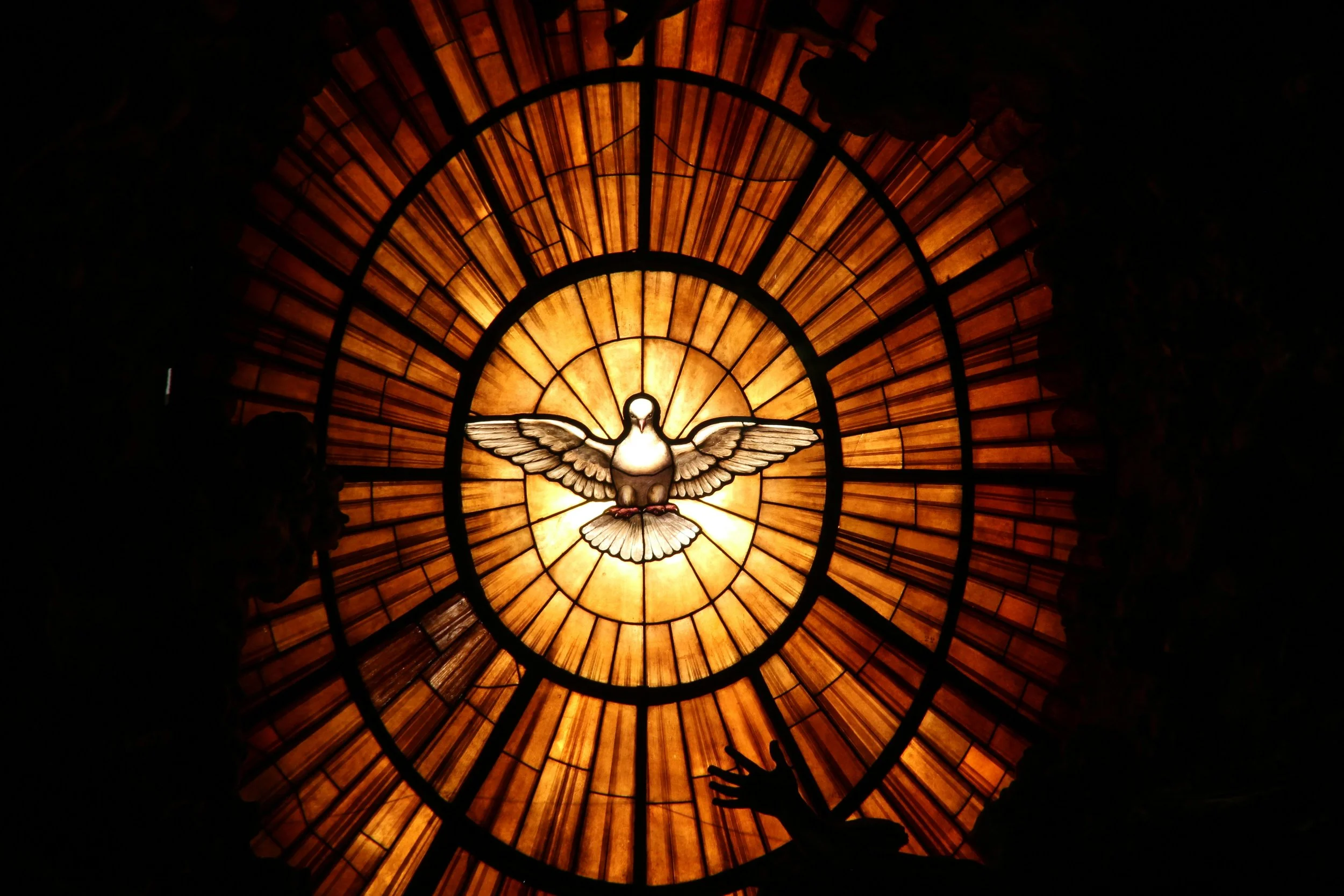
"The Holy Spirit... makes us capable of living a love that does not compromise with injustice... To work for the building of a just society means overcoming every obstacle to the creation of authentic peace." Gustavo Gutiérrez from A Theology of Liberation
The Symphony of the Spirit
Today we celebrate Pentecost—the birth of a counter-cultural movement. We often picture a quiet, serene prayer meeting, but the "violent wind" of the Spirit was actually an irruption of the "absent ones." For too long, the world had been organized by those at the top, forcing a false uniformity that kept the marginalized invisible.
At Pentecost, the Holy Spirit shatters that status quo. The Spirit doesn't demand that we speak the language of the empire to be heard. Instead, God speaks through the diverse tongues of the street, the poor, and the outsider.
The world tells us that for unity, we must have uniformity. It insists that to get along, we should all look, vote, and speak the same. Human history has always tried to force this illusion. In the Tower of Babel story, humanity tried to build a name for themselves by being exactly the same. It was unity fueled entirely by ego. God scattered the languages at Babel because forced uniformity is a prison.
Fast forward to Acts 2. The Spirit descends, and the crowd is bewildered. Why? Because they hear the wonders of God in their own native languages. The Spirit didn’t take away their different languages to make everyone speak one "holy" tongue or force the world to learn Hebrew to hear the Gospel. Instead, the Spirit filled the existing diversity and spoke directly through it.
Unity in the Kin-dom of God is not monotony; it is a "Deep Harmony." In a symphony, if every instrument played a middle-C, you’d have a headache, not music. You need the growl of the cello and the cry of the trumpet. They play the same song, but not the same notes. God meeting people in their native languages is a divine "No" to the idea that any single culture, class, or political shorthand is superior.
This beautifully mirrors what the Kin-dom looks like in practice. Growing up in my regional Quaker community, we practiced decision-making by consensus. It was a beautiful but often tedious process, especially when it came to two particular "characters" who routinely sparred at our annual meetings.
The first was Chuck, the father of a friend of mine. Chuck was always pushing the envelope, arguing that we were too traditional and that new, radical ideas needed to be embraced. On the other side of the room was Georgia. Georgia shuddered at the word "radical." She wanted to fiercely protect the community's traditions and often leaned on Quaker history as her rationale.
These two never agreed. Time and time again, Chuck and Georgia would stand in staunch opposition. We all used to groan when they rose to speak—they were beloved annoyances, but annoyances none-the-less.
But one year, we were deep in a heavy issue of discernment, and Chuck rose to speak. When he finished, predictably, Georgia stood from the other side of the room. Yet, I will never forget what happened next: for the first time, these two polar opposites entirely agreed. Two totally different people, with completely different worldviews and perspectives, were brought into absolute harmony. Discernment happened remarkably fast after that, as we were all simply left in awe of the Spirit moving in that room.
That unexpected harmony is exactly what we see at Pentecost. We often focus on the disciples speaking in tongues, but there is a second miracle happening here: the crowd is listening in tongues. To "listen in tongues" is a theological posture of the heart. It means having a Spirit-led ear that can hear the "wonderful works of God" coming out of a mouth that doesn't look, think, or sound like yours.
In our world today, we usually listen only for "keywords." We listen to see if someone is on our "team." If they don't use our vocabulary, we stop listening. But at Pentecost, the Spirit gave the listeners the ability to hear the sacred through the "other."
Practically, "listening in tongues" requires four shifts in our posture:
Suspending Judgment: Instead of correcting someone’s "accent" or political perspective, we ask, "What is the Spirit saying to me through this person’s unique life?"
Valuing the Foreign: It recognizes that someone whose life experience is totally different from ours—a different race, age, or struggle—holds a dialect of grace we need to hear to understand the full heart of God.
Hearing the Cry of the Oppressed: It is a refusal to let our own comfort deafen us to the struggle of those who suffer under systemic injustice.
Decentering the Powerful: It recognizes that the perspective of the marginalized is exactly where we find a fresh revelation of God.
This isn’t just a nice theological theory; it is a physical, present reality. I learned this firsthand while working as a chaplain in Boston.
One day, I was called to the bedside of a woman in deep distress who had requested a Bible. When I entered the room, she began speaking to me in rapid Portuguese—a language I do not understand. I tried to communicate in my simple Spanish, but we couldn't bridge the gap. Finally, she pointed at the Bible in my hand and motioned for me to pray.
So, I began praying in English, and immediately, she began praying in Portuguese. We prayed together. Perhaps we prayed for the same things, perhaps for different things, but the miracle was that we were together in prayer. Beyond spoken language, there is a place where hearts connect—where listening happens with our whole bodies.
When we step into that space and truly listen in tongues, we move from being merely "charitable" to being true allies. We stop asking, "How can I help you?" and start asking, "How can I stand with you to dismantle the walls that divide us?"
If we only listen to people who speak our language, we will only ever see a tiny sliver of God. We desperately need the tongue of our neighbor to fill in the gaps of our own understanding.
To understand this deeply, we can look to a movement called Liberation Theology, which reminds us that the Gospel is fundamentally about God’s love for the oppressed and the marginalized. In this view, we understand that sin isn't just personal; it is structural. Systems of power try to create peace by erasing differences, telling us to leave our true identities at the door. Pentecost is a protest against that erasure. True unity in Christ is solidarity—the decision to stand together not because we are the same, but because we are all children of God whose freedom is intertwined. As Gustavo Gutiérrez taught, true liberation is found in community and love, not just individual escape.
The Apostle Paul echoes this, telling the Corinthians that there are "varieties of gifts, but the same Spirit." Often, institutions view diversity as a problem to be managed. Pentecost tells us that diversity is the Spirit’s core strategy. Paul writes that if "one member suffers, all suffer together." This is the heartbeat of a "Church of the Poor." Our diversity isn't just a decoration; it's our strength for the struggle.
The Spirit intentionally distributed different gifts so that we would desperately need each other. If you are the "eye" of the body, you see the vision, but you can’t walk there without the "foot." The eye sees the injustice, the hand works for reform, and the voice speaks truth to power.
When we isolate ourselves in echo chambers, we aren't just being socially narrow—we are actively grieving the Holy Spirit. We are saying we don't need the parts of the Body that God specifically placed there. If we ignore the member of the Body who is being discriminated against or impoverished, we are wounding Christ. A Pentecost church cannot remain silent in the face of racism, poverty, or exclusion, because the Spirit that fell on that first day is a Spirit of freedom.
I saw this Spirit of freedom in action during my time in Boston, working alongside a group of chaplains who refused to stay behind closed doors. These chaplains intentionally walk with people on the margins of society. They don’t wait for people to come to a church building; instead, they go out to meet them exactly where they are. They visit folks living on the streets, host communal meals on the Boston Common, and hold open-air religious services where everyone is welcome. In a city filled with towering cathedrals and exclusive institutions, these chaplains remind us that the sanctuary of God is found wherever the marginalized are gathered.
They understand what happened on that first Pentecost. Pentecost did not end with the disciples locking themselves inside for safety; it ended with the upper room doors flying wide open. The disciples didn't just have a nice, private, comfortable meeting. They stepped out into the public square and became a "Way" that openly challenged the dividing walls and oppressive empires of their time.
If we want to be a Pentecost church today, we have to open our doors, step out into our own communities, and listen to the voices we have ignored.
Our call this week is to let the Spirit move us from a "private piety" to a liberating praxis.
Don't just celebrate diversity—defend it.
Don't just listen to different voices—amplify them.
When the fire falls, it is meant to burn away the chains of oppression and light the path toward a world where every tongue can finally speak of God’s justice and peace. Let us be a community that proves to a divided world that you can be beautifully different and still be entirely one.
This week, practice the miracle of listening in tongues. When you meet someone you don't understand, or someone who frustrates you, ask the Spirit: "Give me ears to hear the wonderful works of God in their language." Because when we truly listen, we find that the Spirit is already there, speaking in every voice.
Amen.