Palm & Passion Sunday
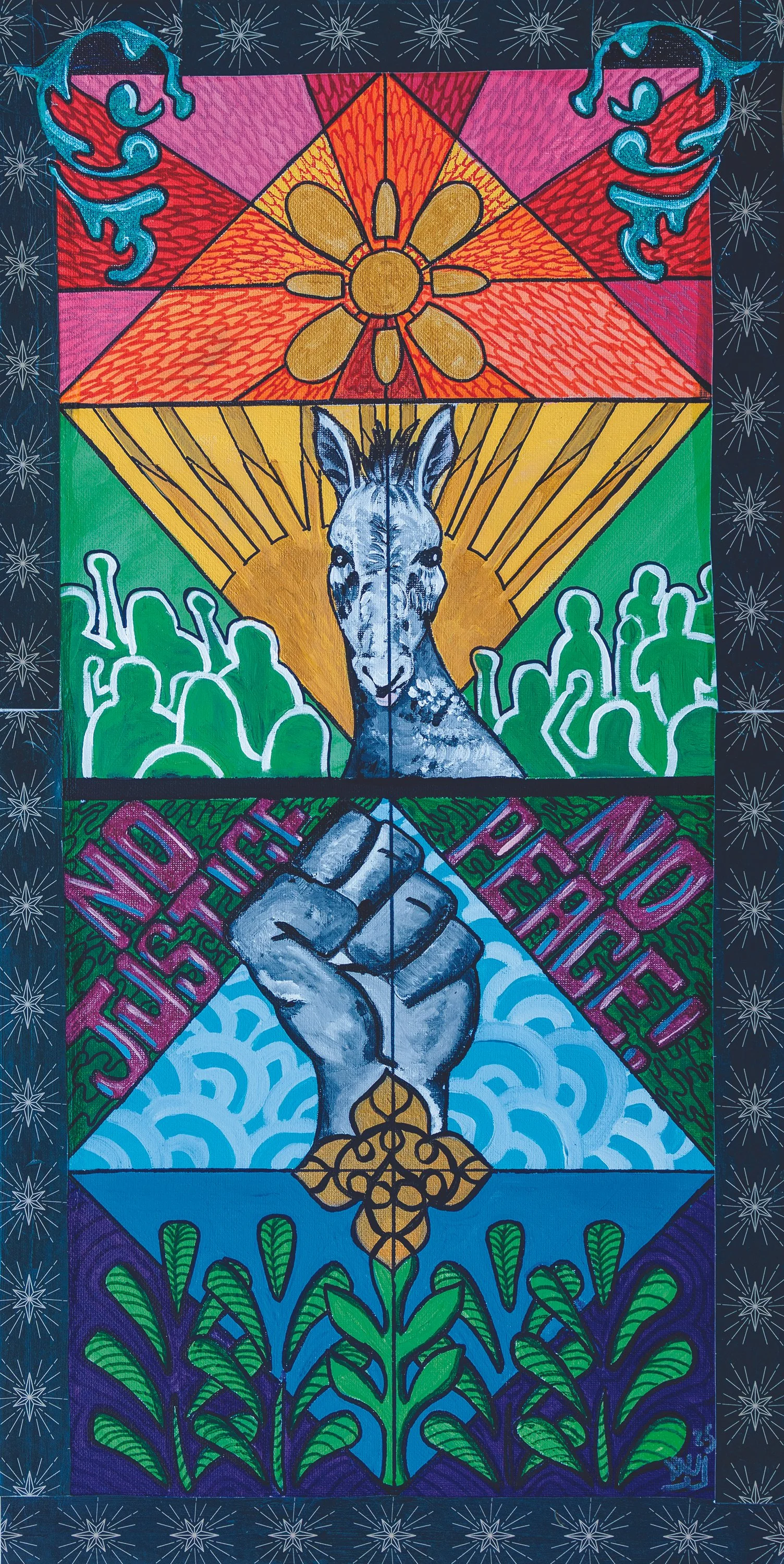
“Not until recently did I realize that I didn't actually know what "hosanna" meant. I'd always assumed it was a synonym for alleluia, an expression of praise. But hosanna and alleluia are not the same. Hosanná is a transliteration of the Hebrew term (hôsî-âh-na) meaning "Oh, save now!" or "Please save!" In other words the crowd at the procession wasn't shouting praises to Jesus. The crowd was begging Jesus to save them. Well that raises an interesting question, from what?”
― Diana Butler Bass
Hosanna: A Command for Deliverance
As many of you know, I didn’t grow up in a liturgical tradition, yet the story of Palm Sunday always occupied a loud corner of my religious imagination. In Quaker history, back in 1656, a man named James Naylor—one of the first "Friends"—decided to live the story out. He rode a donkey into the city of Bristol through the pouring rain while his companions sang "Holy, Holy, Holy" and strewed the muddy ground with their garments.
Naylor wasn't trying to be a celebrity. His point was radical: he believed the "Inner Christ" was present in every human being, and if that were true, then we are all emboldened to act with the same divine authority Jesus had. It sparked a massive controversy that nearly split the early Friends. Some saw it as blasphemy; Naylor saw it as a "sign" of a different kind of kingdom.
I grew up with that tension—the debate over how we show up in the world—set against the backdrop of the song we’ll sing today: Give Me Oil in My Lamp. It was my favorite song to dance to as a kid. But as I’ve sat with James Naylor and this text, I’ve realized I was missing the urgency of the lyrics the crowd was actually shouting.
For years, I thought "Hosanna" was just a churchy way of saying "Hooray!" I thought it was a synonym for "Alleluia" or "Praise God." But it isn’t. "Hosanna" is a transliteration of the Hebrew hôsî-âh-na. It isn't a compliment; it’s a desperate command. It means: “Save us, now!” or “Deliver us, we beg you!”
When the crowd stood at the gates of Jerusalem waving those branches, they weren’t singing a catchy tune for a parade. They were staging a demonstration. They were a people at the end of their rope, shouting at a revolutionary to pull them out of the wreckage of their lives.
In the first century, the people of Jerusalem lived under an "occupied peace." It was a peace maintained by heavy taxes, by the threat of the cross, and by the crushing weight of an empire that saw people as resources rather than souls.
When Jesus rode in on that donkey, he wasn't just fulfilling an old prophecy from Zechariah about a humble king; he was performing a piece of street theater. He was mocking Pax Romana. He was showing that God’s authority doesn't arrive on a warhorse or with a legion of men with spears. God’s authority arrives on a peaceful beast, unarmed and unafraid.
The people shouted "Save us!" because they were exhausted by the violence of the status quo. They weren’t asking for a "spiritual" salvation that would take effect after they died; they wanted to be saved from the misery of the here and now. They were shouting, "Jesus, break this system! Now!"
This helps us understand why the week ends so violently. We often wonder how a crowd could cheer on Sunday and shout "Crucify him" on Friday. I don't think it was because they were fickle. I think it was because they were terrified.
When the Roman authorities finally moved in—when the "savior" they hoped would lead a coup was instead arrested, mocked, and beaten—the illusion of safety vanished. The crowd realized that waving palms wouldn’t stop a Roman spear. They did what fearful people often do: they retreated. They chose the "peace" of silence over the danger of the revolution. By Friday, they weren't begging Jesus to save them; they were just hoping the authorities wouldn't notice they had been there on Sunday.
And here we are today. We look at our own world—at the headlines of violence in our schools, the exploitation of the earth, and a "peace" that seems to only benefit those at the very top. We realize that the empires of money and privilege offer us false security.
This year, I find it hard to get to the "Alleluias." Praise feels heavy. But I have plenty of "Hosannas."
To cry "Hosanna" today is to look at the injustice of our world and shout: “God, pay attention! Save us, now!” It is an act of holy protest. Waving these palms isn’t a rehearsal for a celebration; it’s a commitment to a movement. Like James Naylor, we are declaring that the "Light" within us cannot be compatible with the darkness of oppression.
The miracle of Holy Week is that Jesus doesn't abandon the people who gave up on Friday. He doesn't save the world by out-killing the empire; he saves the world by absorbing its violence and rising anyway. He shows us that while the tyrants can break a body, no one cannot break the Truth.
So today, we don't just dance to a folk song. We join the "Lamb’s War." We acknowledge that the road to the Kingdom is difficult, but it is the only road worth walking.
Until the world is made whole, let us be a people of the "Hosanna." Let us wave our palms against everything that breaks God’s heart. In our cars, in our streets, and in our deepest prayers: let us sing Hosanna! Save us! Now!
Amen.