Cultivating a Future for Our Faith: World Communion Sunday
“I never look at the masses as my responsibility. I look at the individual. I can love only one person at a time. I can feed only one person at a time. Just one, one, one.” ~ Mother Teresa
Cultivating A Future for Our Faith
Last year around this time, I stood before you and shared a story from my time traveling with Community Peacemaker Teams in Kurdistan, Northern Iraq, back in 2011. It is a memory that has lived deeply within me, but it bubbled up to the surface in a fresh way recently while I was working in my garden. Let me share it with you again.
One afternoon, our team of human rights reporters and international solidarity workers drove quite close to the Iranian border, high up into a mountain village. We were welcomed into a family's home and shared a simple, beautiful meal of honeycomb, yogurt, and cheese—all foods that had been harvested and raised by the family on their own land. But the peace of that meal was fragile. While we were eating, we heard a small, sharp explosion outside.
All of our team froze.
Our host simply shook his head sadly, sighed, and said, “There goes another chicken.”
We learned from this family that the farm was surrounded by active landmines, remnants of a conflict that refuse to leave the soil, and chickens simply don’t learn where not to step.
After dinner, feeling a deep tug in my spirit, I pulled our translator aside and mentioned that I had brought a gift for the family. This wasn’t something our teams usually did, but this moment felt different. Our group and the family gathered together in a small circle, and I reached into my bag and pulled out tiny, hand-labeled packets of seeds. Back home in Philadelphia, I had been part of a seed-saving collective, and a few friends had helped me gather these seeds to bring along—just in case a moment ever felt right to offer them.
As I held out the packets to the farmer, his eyes welled up with tears. He didn't just accept them; he turned and gestured to his son, who went and pulled out a worn, rusty tin. The farmer opened it, took a small bag, and carefully filled it with a few of his own saved seeds. We sat there, translating not political updates or human rights violations, but cultivation information. How deep to plant. How much water. How to care for the soil.
Before we left, the farmer patted my arm, looked me directly in the eye, and said: “You give us hope. We haven’t had any for a long time. But if there are people in the world like you all—people who understand seeds and understand the earth—then we have hope. Thank you.”
I shared that story with you last autumn. But the reason it returned to me this year, while my hands were in the dirt, is because of a confession.
After I preached that sermon last year, a wave of conviction hit me. I realized I had been careless. Over the many years since 2011, I had planted a few of those Iraqi tomato seeds in my garden. I watched them grow, enjoyed their fruit, but year after year, I carelessly neglected to actually save the next generation of seeds. I had forgotten exactly which tomato plants they were, letting the legacy slip through my fingers.
So this past spring, with a renewed conviction to honor the holy weight of that exchange, I went searching. I found the last remaining seeds from 2011. I prayed they weren't too old. To my absolute joy, a few were still viable. I nurtured them, watched them sprout, and grew three distinct plants for one specific, sacred purpose: to save their seeds.
A few weeks ago, as I cut open the ripe, heavy fruit, scooped out the slick pulp, and set the seeds to ferment on my kitchen counter in a little dish of water, a profound sense of connection washed over me. I closed my eyes and imagined that farmer, living on the volatile border of Iraq and Iran, standing at his own table, doing the exact same thing.
I don’t know if he is still on that mountain. I don’t know if he is still alive. But he is alive in my memory, he is alive in my heart, and he is alive in the genetic memory of the fruit on my counter. As the seeds fermented, and I rinsed them clear and set them out to dry, I wondered about the land on that mountaintop. I wondered if the chickens were still stepping where they shouldn’t. I wondered about how we cultivate hope and faith when we are facing a deeply uncertain future.
The farmer’s words echoed in my kitchen: “If there are people in the world who understand seeds and understand the earth, then we have hope.”
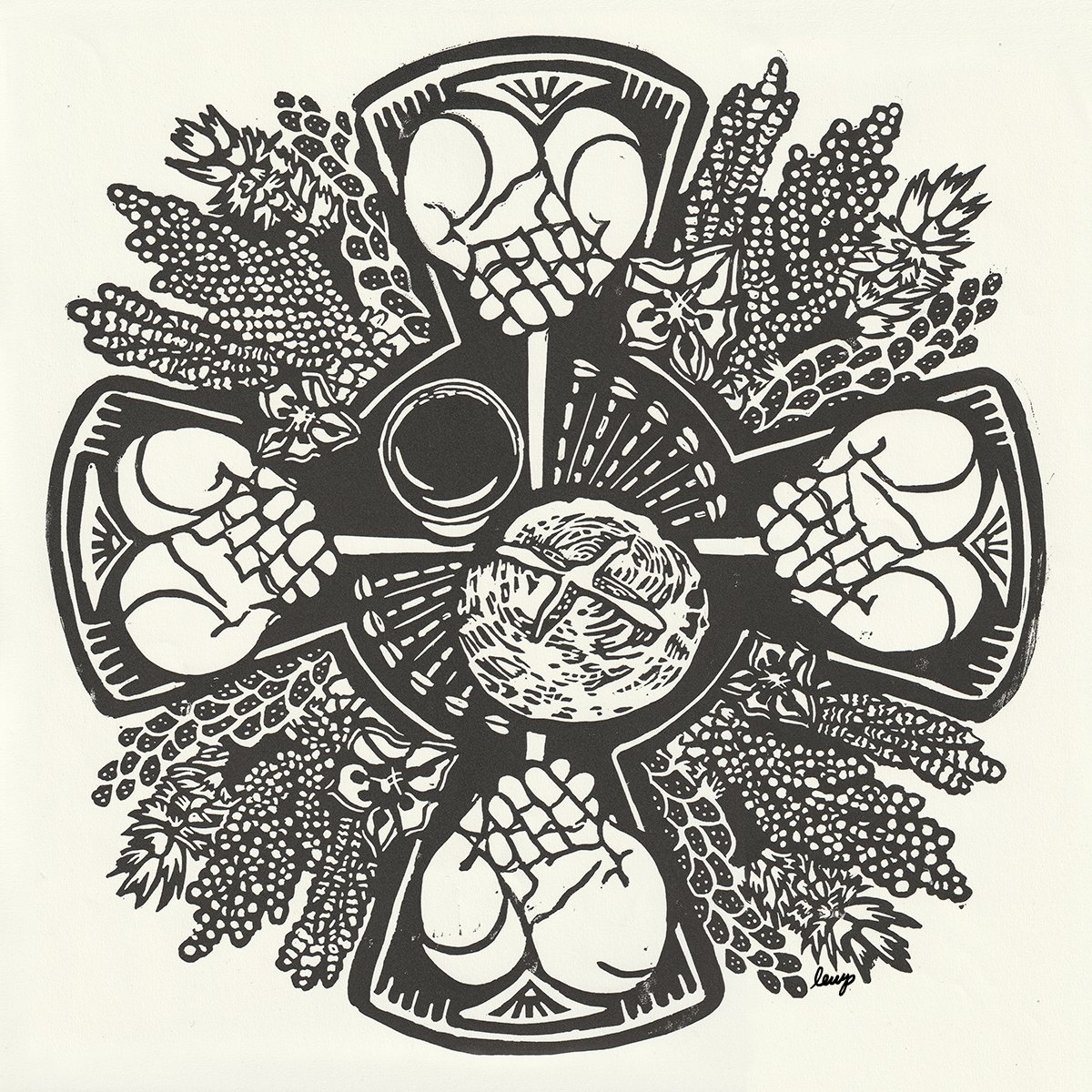
Today is World Communion Sunday. On this Sunday, churches all across the globe gather around a table to break bread and pour the cup. But if we are honest, holding up a loaf of bread today feels complex. It forces us to ask: What does it mean to tend the earth and share its abundance in a world that feels like it’s teetering on the edge?
Everywhere we look, the landscape is shifting under our feet. If you read the work of environmental journalist Dan Egan, particularly his eye-opening books The Death and Life of the Great Lakes and The Devil's Element, you know exactly how fragile our relationship with the earth has become. Egan chronicles how human overreach, pollution, invasive species, and our frantic over-reliance on chemical fertilizers have caused toxic algal blooms and disrupted the very systems of freshwater that sustain us. He writes not from a place of cheap optimism, but with a sobering clarity: we have treated the earth as an infinite vending machine rather than a living sanctuary.
And our anxieties aren't just ecological. As we look toward the future, a new kind of dread has crept into our collective consciousness. We hear tech leaders and philosophers talk about the existential threat of Artificial Intelligence—systems that could outthink us, replace human connection, distort truth, or spiral beyond our control. We watch the nightly news, and it feels like the ancient, apocalyptic warnings of the "end of the world" have been repackaged into modern algorithms and climate models. We feel small. We feel obsolete. We look at the systemic landmines of war, technology, and ecological collapse, and like those chickens, we wonder when the next explosion will happen.
We ask the same question the disciples asked when standing on a desolate hillside, surrounded by a hungry crowd of five thousand people: "What are we supposed to do with this?"
In the Gospel story of the Feeding of the Five Thousand, the disciples look out at a massive, overwhelming problem. Five thousand hungry men, plus women and children, out in the wilderness as the sun is setting. The disciples analyze the situation using the logic of the empire: scarcity. They tell Jesus, "Send the crowds away so they can go into the villages and buy food for themselves." In other words: This problem is too big for us. The resources don't exist. Let them fend for themselves.
It’s the exact same anxiety we feel today when faced with climate change or technological displacement. The problem is too big. We are out of time. The world is ending.
But then, a small act of kindness disrupts the narrative. A young boy steps forward. In the middle of an existential food crisis, he offers what he has: five barley loaves and two small fish.
It is an absurdly small offering. It is completely insufficient. The disciple Andrew even mocks it, saying, "But what are they among so many?"
Isn't that what we say to ourselves? What good is my small backyard garden in the face of global agricultural collapse? What good is my vote, my protest, or my small act of kindness against the tide of autonomous AI and global corporate greed?
But look at what Jesus does. He doesn’t wait for a miraculous supply drop from heaven. He takes what is already there—the small, imperfect, vulnerable offering—and he blesses it. He breaks it. And he hands it back to the people to distribute.
The miracle of the feeding of the five thousand is not just about multiplying calories; it is a profound lesson in tending the community and trusting the earth. When people stopped hoarding out of fear, when they sat down in circles on the green grass, looked each other in the eye, and began to share the little they had, the illusion of scarcity vanished. Not only did everyone eat and feel satisfied, but they gathered up twelve baskets of leftovers.
The story tells us that the earth and our communities already contain exactly what we need to survive, if we learn how to share, how to distribute, and how to care for one another.
Today we are called to look at the fears of the "end of the world"—whether driven by environmental degradation or technological anxiety—and respond with a theology of the seed, a liturgy of the loaf.
Dan Egan’s work reminds us that nature has a powerful, God-given capacity to heal itself if humans practice humility and restraint. We don’t need to dominate the planet, and we don’t need to cede our humanity to machines. AI can generate text, it can process data, it can mimic human patterns—but AI cannot dig its fingers into the warm, damp soil. AI cannot look a weeping farmer in the eyes and share the sacred silence of mutual hope. AI cannot save a seed, ferreting life forward through generations out of sheer love.
That belongs to us. That is the unique, holy calling of being human.
When we gather at this communion table today, we are rejecting the empire's myth of scarcity and the algorithms of despair. We are declaring that the future is not a predetermined wasteland run by machines or ruined by greed. The future is a garden waiting to be tended.
Every time you practice a small act of kindness—every time you feed a neighbor, check on an elder, reduce your consumption to let the waters heal, or teach a child how to plant a seed—you are bringing your five loaves and two fish to Jesus. You are saying, “It isn’t much, but I trust that love can multiply it.”
Friends, let us not be like the chickens, blindly stepping on the landmines of fear and polarization. Let us be the people who understand seeds, who understand the earth, and who understand the human heart.
The tomato seeds on my kitchen counter took months of attention, fermentation, and waiting in the dark to become viable for next year. That is how hope works. It is quiet. It is dirty. It requires patience.
Let us break this bread today in global solidarity—with the seed-savers in Kurdistan, the scientists fighting for our freshwater lakes, and the quiet peacemakers everywhere. The world is not ending; the old, destructive ways of living are giving way to something new. And right here, around this table, the seeds of God's Kin-dom are taking root.
Amen.